
Why Presidential & Government Projects in Accra Design With Architects Afrique
A government building is a constitutional act in stone and glass. A ministry, a civic hall, or a ceremonial space does not merely house a function — it projects the permanence of the republic, the dignity of the office, and a continuity that must read across administrations and generations. Architects Afrique has designed for Ghana’s institutional clients since 1984, and we understand that a state commission is held to a different standard: it must look the part on inauguration day and still command the same authority thirty years later.
State architecture in Ghana also operates under the most demanding governance of any sector. Public-sector projects move through procurement frameworks, security requirements, and accessibility obligations that shape the design from the first sketch. We design with that framework in view, so the building that emerges is not only dignified and durable but procurable, approvable, and compliant — a project that can pass scrutiny as confidently as it carries authority.
What Presidential & Government Architecture Demands
State-Grade Authority & Permanence
Civic and ceremonial buildings must project constitutional gravity — generous entrance sequences, dignified reception and assembly spaces, and a material language that signals permanence rather than fashion. We design with a confident African architectural identity so the building reads as Ghanaian, institutional, and enduring, not as a borrowed foreign template.
Security & Controlled Circulation
State buildings are designed around controlled access and the clear separation of public, official, and secure zones — protected approaches, screening and entry sequences, and circulation that keeps dignitaries, staff, and the public on the right paths. We coordinate these provisions into the architecture from concept, working with the engineer and the client’s security advisers.
Procurement & Compliance Discipline
Public commissions carry documentation obligations at every stage — approvable permit drawings, a complete construction document set, and the specifications a transparent tender requires. We produce the document set that lets a government project be priced accurately, awarded cleanly, and built to what was approved.
Our Presidential & Government Design Scope
- Architects in Ghana — concept, developed design, permit drawings, and construction documentation for institutional commissions
- Commercial Architecture — offices, departmental buildings, and agency premises designed to perform and gain approval
- Signature Commercial — flagship civic and ceremonial buildings where the architecture is itself a statement of state authority
- Design-Build Services — design and construction under one accountable team for cost and programme control
- Architectural & Construction Integration — design carried through to a built, signed-off result
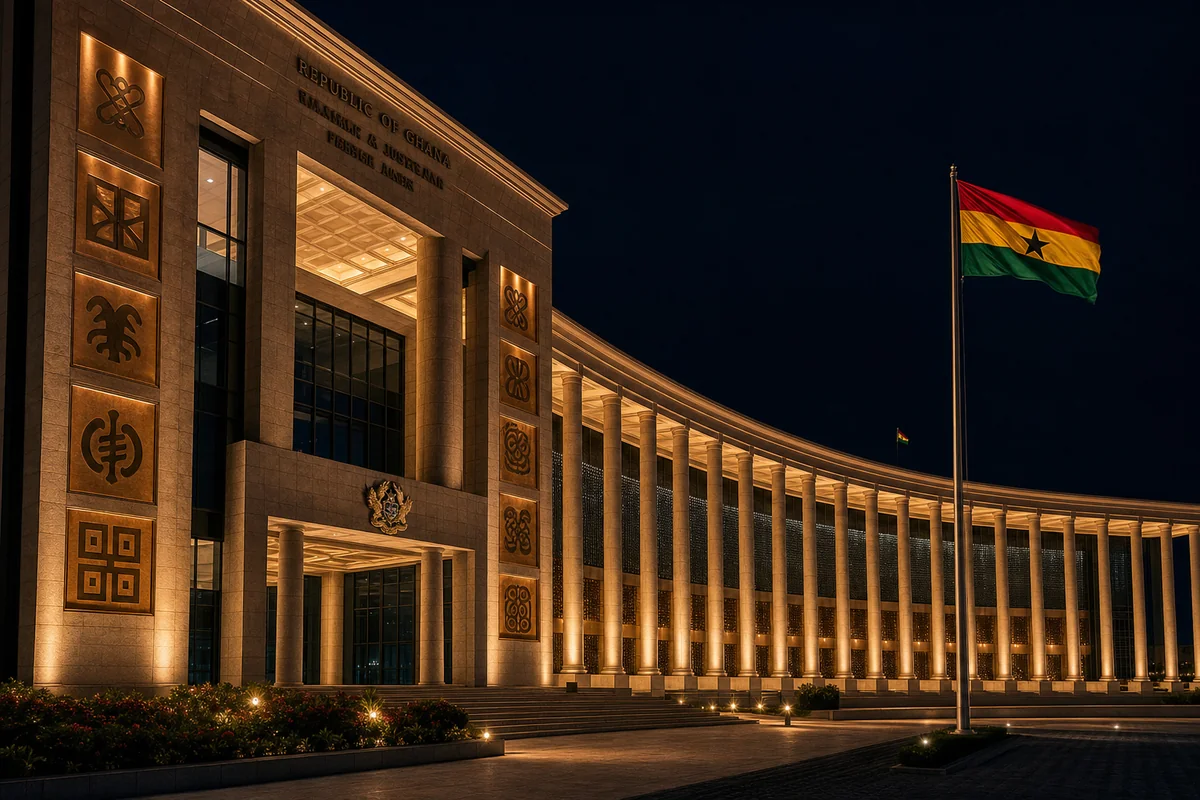
We can deliver design only — a complete, tender-ready document set the procuring entity takes to a contractor — or a design-build commission where one accountable team carries the project from brief to built result.
Registered & Accountable
- Works within the Architects Act 1969 (NLCD 357) and the Architects Registration Council (ARC) / Ghana Institute of Architects (GIA)
- Registered engineering input (GhIE) on the structure and services a state building requires
- Designed to Ghana’s building regulations (L.I. 1630) and the Ghana Building Code (GS 1207:2018)
- EPA permitting (L.I. 1652) and District Assembly / Lands Commission permit drawings handled as part of the service
- Established 1984 — a real practice with an institutional portfolio, shared on request
Consultation & Portfolio
A government commission begins with a working conversation, not a price. We meet the procuring entity and the user department, understand the brief, the site, and the security and accessibility requirements, and test what is feasible before any design begins. An architect’s fee is agreed as a percentage of the construction cost (the GIA publishes a fee scale as guidance) or as a staged fee for the design work — known up front, and separate from the cost of the building itself, which comes from a Bill of Quantities once the design is set. Book a design consultation and ask to view our institutional portfolio.
Presidential & Government Across Accra
We design for government and institutional clients across Ridge, Cantonments, and Airport City — Accra’s government and diplomatic quarters — with the capacity to deliver civic projects in Kumasi, Takoradi, and Lomé, Togo. Briefs and design reviews can be run on site or by video, with drawings shared for approval and the build managed with progress reporting.